
Claude Chat and Cowork Now Share One Editable Memory
Anthropic merged the memory used in Claude chat with the memory used in Claude Cowork on 25 August 2026. The store is on by default for Free, Pro, and Max, and every topic can be read, edited, or deleted.
PromptCrates Editorial
Staff Writer
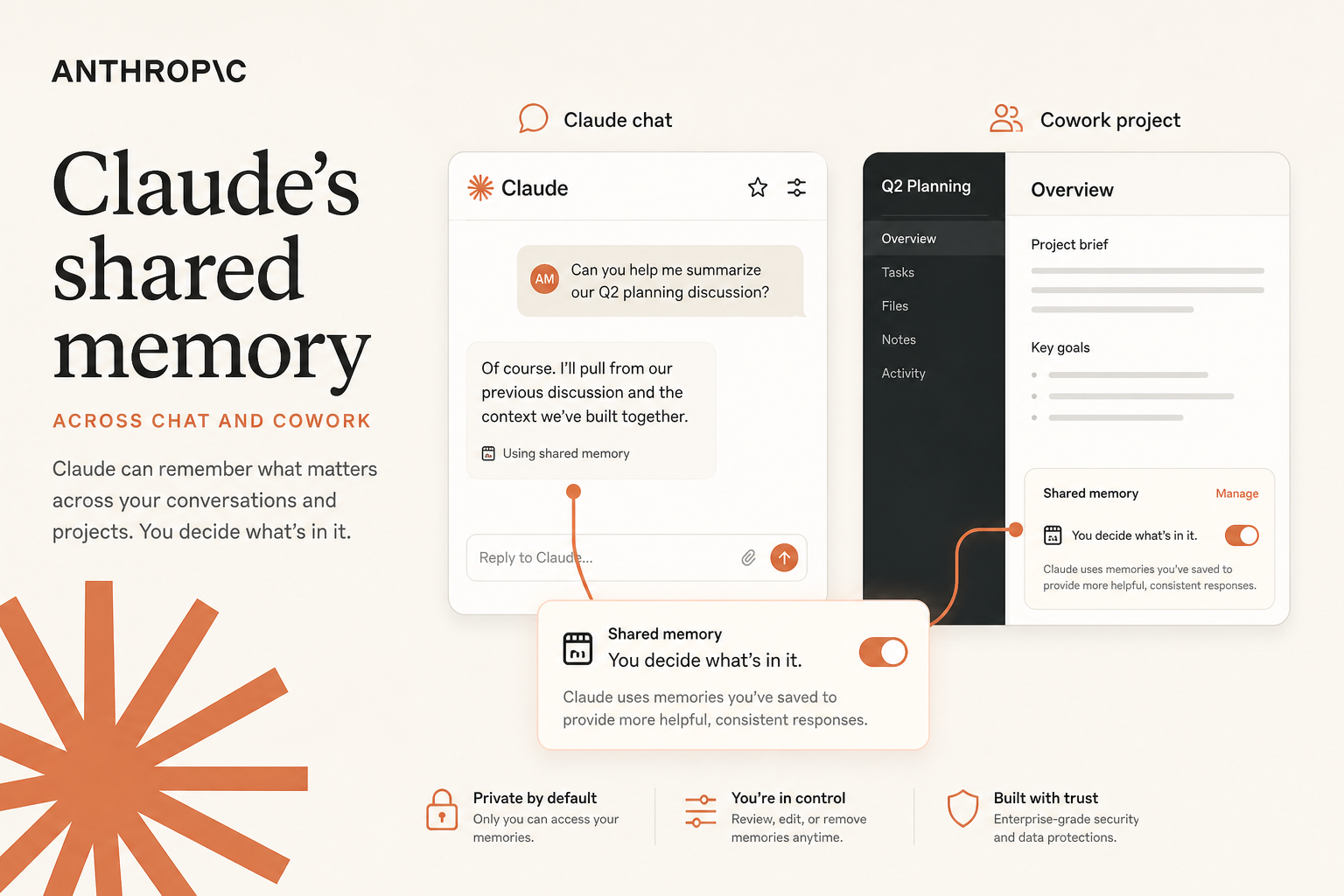
Anthropic merged Claude chat and Claude Cowork into one memory on 25 August 2026. The shared store is on by default for Free, Pro, and Max, and it exposes topic files users can read, edit, or delete.
Why Anthropic put chat and Cowork on one editable memory
This is a memory-system merge, not a new model and not a new Cowork seat. Anthropic said the memory used in chat is now the same memory used in Claude Cowork. Context from months of chats is available the moment a Cowork cloud task starts, and what Cowork learns carries back to chat.
TechCrunch framed the change as ending the need to rebrief Cowork on project details already discussed in chat. That is the product claim. Two panes, one file. Before Tuesday, a brief built in chat stayed in chat. Handing Cowork a cloud task meant starting the project over.
Anthropic's examples stay small: a manager update that already knows the audience, or a conference budget that already has headcount, city, and speakers.
The write path changed with the merge. Claude now adds topics to memory while you chat instead of summarizing after a conversation ends. Mention that a project deadline moved to September, and the next thread already has the date. You do not have to say "remember this." You can pause memory or reset it at any time.
Treat that as a timing change, not a promise that every aside becomes a topic. Anthropic did not publish how many topics a chat creates or which phrases trigger a write.
If you already track Anthropic's $5 million AI wellbeing evaluation grants, keep that as a research-funding story. Shared memory is a product file behind two consumer surfaces. One is a grant program. The other is a Topics list you can open today.
What Claude writes live, and what stays out of memory
Everything Claude remembers is a list of short files under Topics in Settings > Memory. Users can read, edit, or delete each file. A correction applies everywhere afterwards. Change an old company name in one file and every later conversation gets the new name.
The default store is not a dump of the whole thread. By default Claude does not store health, race, ethnicity, religious beliefs, politics, gender identity, and similar sensitive topics. Users who want those topics remembered can turn on "include sensitive topics in memory." That switch is forward-looking only. Older chats are not scanned retroactively. Each time Claude saves one of those topics, the product shows a notice. The setting can be turned off at any time.
Some classes sit below that switch. Even with sensitive topics on, Claude still will not store SSNs or government IDs, criminal history, immigration status, or Acceptable Use Policy violations. Anthropic says Claude will tell you when it cannot update memory with that class of information. Never, here, is a hard exclusion. It is not an opt-in waiting one setting deeper.
Do not invent a retention period, a topic cap, or a deletion SLA. The 25 August post does not give those numbers.
If your team already routes coding work through GPT-5.6 Sol, Terra, and Luna in AWS Kiro, do not put this merge in that picker. Kiro is OpenAI's coding-agent surface with its own credits. This post is about Claude chat and Cowork sharing one user-visible memory file.
Which plans start on, and why Claude Code stays out
Memory is on by default on Free, Pro, and Max across web, desktop, and mobile. iOS and Android need the latest app. For Team and Enterprise, admins control availability and memory stays off for users until they turn it on.
That is a plan matrix, not a geography matrix. A Free user on the web gets the store unless they pause or reset it. A Pro or Max user on desktop or mobile gets the same default. A Team or Enterprise org does not. An admin there has to turn availability on. Until they do, the two surfaces do not share a file.
The Register reported Claude Code's memory stays separate. Anthropic told them there is no option to keep chat and Cowork memories on different stores except by using different accounts. Code does not join the merge in this announcement.
Do not flatten Free, Pro, Max, Team, Enterprise, and Code into "Claude now remembers." The first three start on. The last two org plans start off. Code stays on its own store. The only way to keep chat and Cowork apart is a different account, a pause, a reset, or a manual prune of Topics.
If you already watch Keenable's $26 million web-search index for AI agents, keep index and memory apart. Keenable is a search index other agents can query. Claude's Topics file is a user-editable brief that now follows you from chat into a Cowork cloud task.
What to pin after the 25 August merge
Put the store in the wrapper, not in a chat line that says "remember this." If a topic is wrong, edit the file. If the org is not ready, leave Team and Enterprise off. If the work lives in Claude Code, do not assume the Cowork brief is sitting there.
The useful line is the 25 August merge, the live write, the Topics controls, the two default layers, the never-save list, the plan split, and the Code carve-out. A paragraph that only says "Claude remembers now" does not belong in the changelog.
Sources
- Claude's memory works everywhere, and you decide what's in it — Anthropic, 25 August 2026
- Claude Cowork finally remembers what you told the app in chat — TechCrunch, 25 August 2026


