Bill Gates Pushes a Robot Tax and Human-Reserved Jobs
Bill Gates published a nearly 6,000-word Gates Notes essay on 26 August 2026 arguing that AI has already crossed danger thresholds. He proposed a robot and token tax plus Human Reserved job categories, and MIT Technology Review, The Verge, and TechCrunch covered the memo the same day.
PromptCrates Editorial
Staff Writer
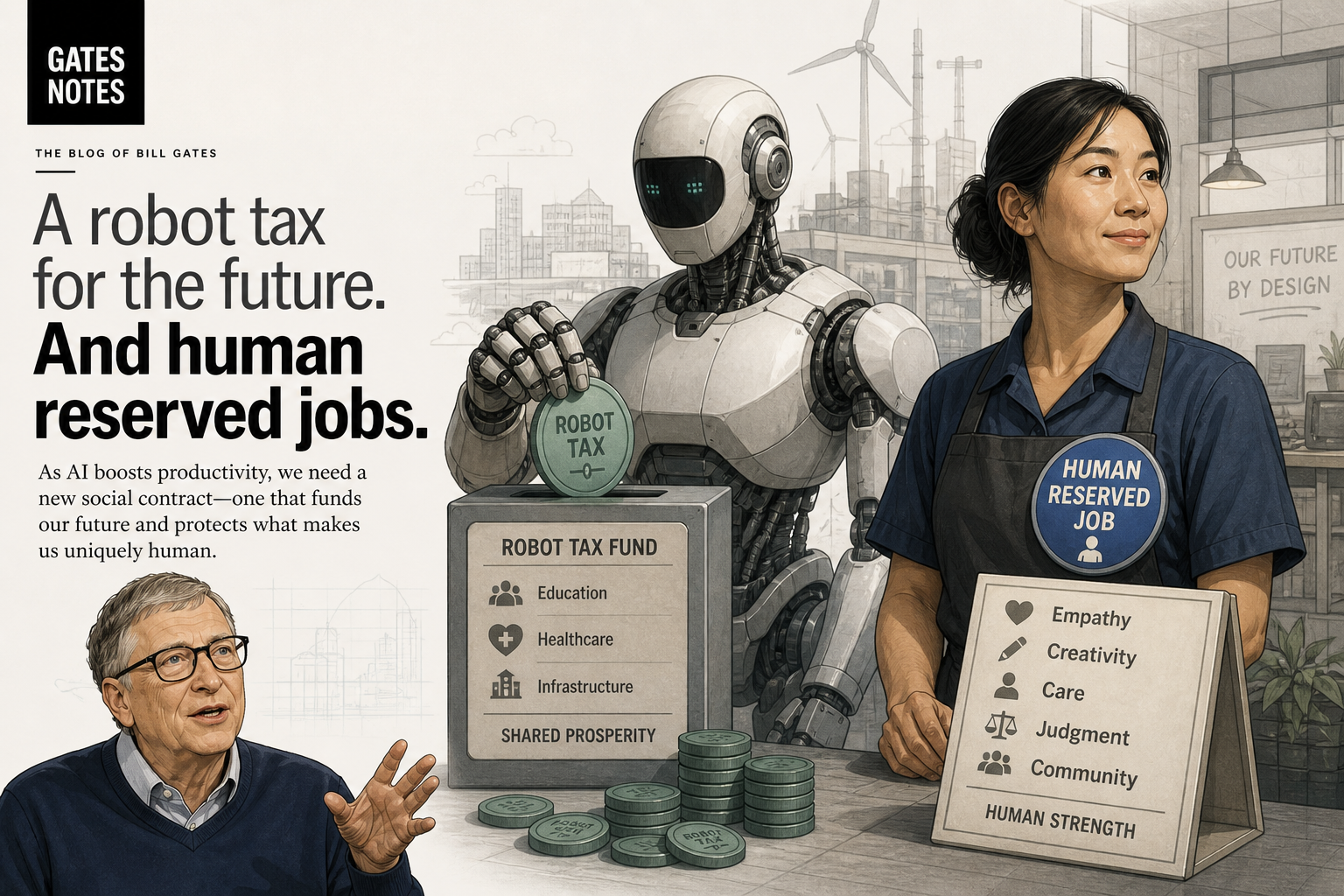
Bill Gates published a nearly 6,000-word Gates Notes essay on 26 August 2026 titled "The turbulent AI era is here. The choices we make now are critical." He proposed a robot tax and Human Reserved job categories after telling MIT Technology Review that AI has already crossed bio, cyber, psychosocial, job-market, and control thresholds.
Why Gates put a robot tax back on the table
The Verge's Robert Hart filed at 11:07 UTC on 26 August 2026 and called the memo a bleak turn from Gates's more hopeful 2023 AI essay. TechCrunch posted at 07:37 PDT the same day and treated two ideas as the news: a robot tax, and a Human Reserved domain. MIT Technology Review's Mat Honan interviewed Gates in Kirkland, Washington, the same day. Those three pieces plus the essay title are the file. Do not invent a White House bill number.
Gates's labor arithmetic is the one he has used before, restated. Right now, he wrote, an employer pays payroll taxes on a human hire and can usually write a robot off immediately as a business expense. The tax system nudges firms toward machines. A tax would slow that rush a little and raise money for retraining and a stronger safety net. In the MIT interview he floated a concrete split: 50% of token-tax revenue paid to the government to help people who lose work to AI. He described a token tax as a sales tax or value-added tax, "vertically oriented like an alcohol, tobacco, or luxury-type tax," not as the government taking voting shares.
He said the world is not rich enough to afford universal basic income, that the next 10 to 20 years will be tumultuous, and that abundance — if it arrives — is at least a decade away. TechCrunch noted both the robot tax and Human Reserved rules would dent major-lab profits, and that who would set the rules remains unanswered.
If you already watch Alabama's attorney general subpoenaing OpenAI, keep a state legal process and this policy essay on two lines. A subpoena is one attorney general. Gates is asking Washington and other capitals for a tax design.
What Human Reserved would wall off, and what it would not
Human Reserved is a designation, not a union card. Gates said some roles should be barred from AI for economic reasons — because replacing them would dump people who cannot easily change jobs. TechCrunch quoted his construction example: you cannot tell a 55-year-old who has worked in construction an entire career to go work at an elder-care facility and expect that to feel fulfilling. Other roles are reserved for social reasons. In health, he asked readers to imagine a robot delivering the news of an incurable disease. There is no technical reason it could not. He said it should not.
The domain can evolve. Some jobs might be set aside now and opened to AI over years or decades, with a commitment to preserve some human work. In the MIT interview he said the mix of reserved work might land anywhere from 10% to 15% of jobs up toward 30% or 40%, and that getting to 50% would be a different society of shorter weeks and earlier retirement. Those percentages are his ranges for a future policy debate. They are not a statute.
He did not pick a U.S. job list. Childcare, teachers next to AI tutors, and mental-health escalation were examples. Country-by-country rules would need an import adjustment, he said, analogous to the European Union's carbon border mechanism. Do not write a federal occupation schedule he did not publish.
If you already follow Anthropic's $45 billion Nscale Vera Rubin build in West Virginia, keep a compute campus and this labor-policy memo apart. Nscale is capacity. Human Reserved is a proposed legal category.
The thresholds Gates says the world has already crossed
The MIT interview is the danger file. Gates said the world has crossed thresholds on bio-capabilities, cyber-capabilities, psychosocial capabilities, job-market-destruction capabilities, and even a lack of control. He said he is stunned at the lack of concern outside the industry. He called himself a "shrill voice" and said people had promised to figure out the guardrails when those thresholds arrived.
On biology he was specific. "Any model that can make novel molecules should be monitored." He said those models should not be copyable into a dark place that strips the monitoring logic, and that the United States should approach China on that rule. He views bioterrorism risk as about 50 times scarier and more likely than a natural pandemic risk. He said he will write a separate bio memo before the end of the year.
He also said if someone had a credible plan for slowing AI advances globally, he would likely support it. He does not think a slowdown is sustainable. TechCrunch placed him with people who like the Pacing the Frontier open letter and doubt it will hold. He wants a new international organization for risks that cross borders, inspired by nuclear, aviation, and ozone agreements, and he said countries should start building it now. U.S.–China cooperation is required. He did not spell out the mechanism.
The Verge pulled the line that AI will either be "the greatest equalizer ever invented, or the worst source of injustice," and that "many jobs will disappear forever." Leaders, he said, need to act before unemployment rises and public trust erodes.
If you already have OpenAI's official report on the Hugging Face incident as a control-failure case, keep that July evaluation post-mortem and this Gates memo on two lines. OpenAI published a technical incident. Gates is arguing the control threshold is already a public problem.
The useful pin is: on 26 August 2026 Gates published a nearly 6,000-word essay and sat for MIT Technology Review; he says bio, cyber, psychosocial, job-market, and control thresholds are crossed; bioterrorism is about 50 times the natural-pandemic risk in his view; he wants models that make novel molecules monitored, including with China; he proposes a robot and token tax, including a 50% government share of token-tax revenue, plus Human Reserved jobs; he would back a global slowdown if it were credible and doubts it is.
If your policy memo still says Gates is an unalloyed AI optimist, replace that line. The 26 August file is a robot tax, a reserved-job list, and a claim that the danger thresholds have already been passed.
Sources
- Bill Gates wants to see a robot tax and 'Human Reserved' jobs to mitigate harms from AI — TechCrunch, 26 August 2026
- Bill Gates says we've passed AI's danger thresholds. Now what? — MIT Technology Review, 26 August 2026