Slack Code Opens Dedicated Channels for Coding Agents
Slack launched Slack Code on 20 August 2026 at 12:00 PM UTC (19:00 WIB), with dedicated code channels for Claude, Devin, GitHub Copilot, and Vercel. Over 70% of those channels go from idea to a merged pull request and close within a single day.
PromptCrates Editorial
Staff Writer
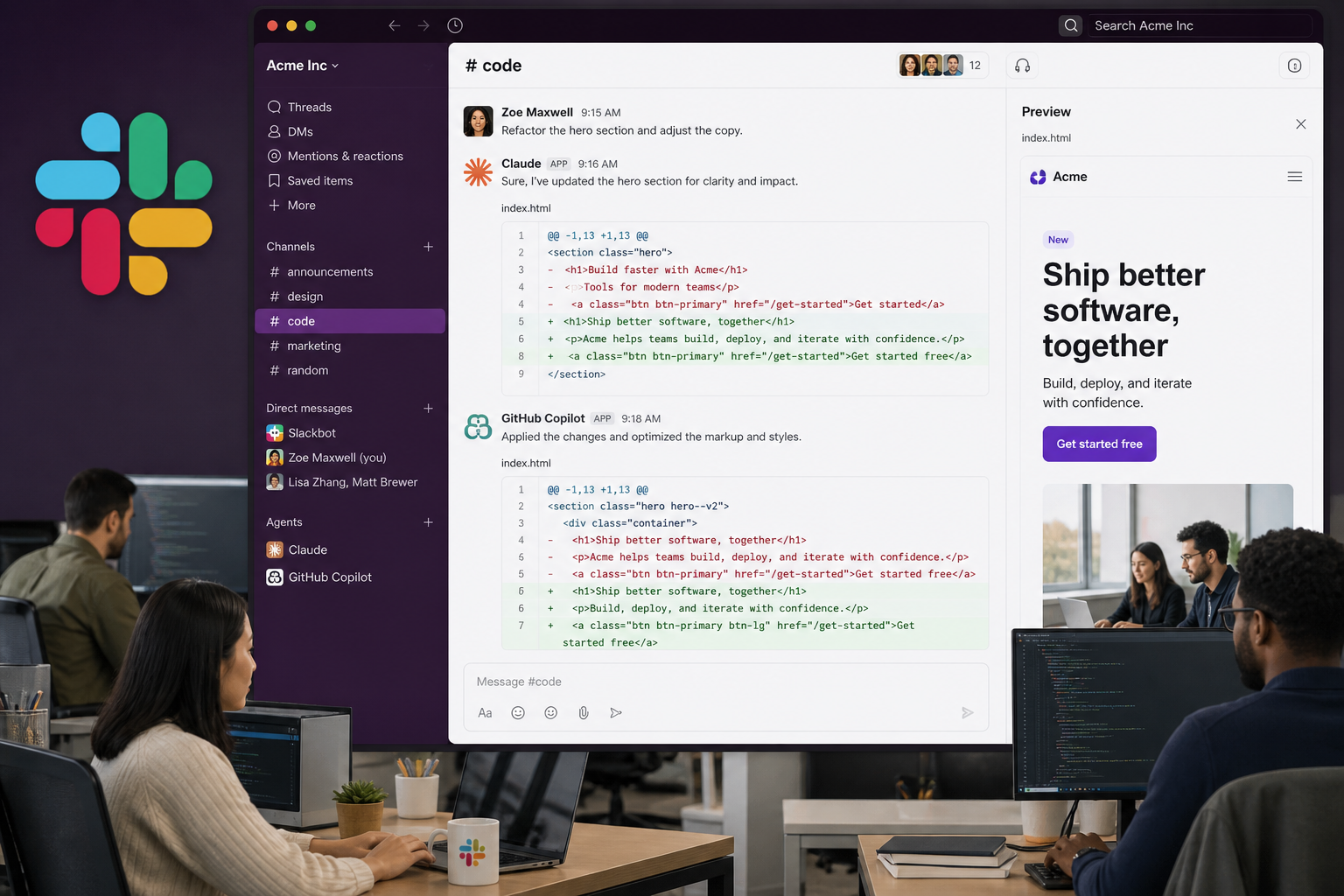
Slack launched Slack Code on 20 August 2026, dated by The Verge at 12:00 PM UTC (19:00 WIB). Mention a coding agent and Slack spins up a dedicated code channel with diffs, planning docs, and a live HTML preview. Slack says over 70% of those rooms go from idea to a merged pull request and close inside a single day.
What Slack Code puts in a code channel
The product is a task room, not another general chat. Someone names a coding agent on real work. Slack Code opens a code channel, brings in people on the team, and the agent fills that room with the artifacts the job needs: a diff, a planning document, or a live HTML preview.
When the job is done, the channel archives itself. It remains searchable, so the trail can be pulled up later. The design goal is simple: keep the agent next to the conversation the team was already having, then get the extra room out of the sidebar.
Slack Code is on any Slack plan. Teams still need their own access to the partner agents. Admin and access rules come from the Slack workspace you already run. Slack Code does not ask IT to stand up a second permission model.
Slack also added an Agents & Tools tab as a home for agent conversations across threads, DMs, and code channels.
A skill prompt that tells people to hide with a bot in a private tab is now the wrong default. The skill should name the agent, name who must approve, and say that the work happens in a code channel, not in a silent side session.
Partners live today, ChatGPT soon
Slack is launching Slack Code with Anthropic, Cognition, GitHub, OpenAI, and Vercel.
It is live today for Claude, Devin, GitHub Copilot, and Vercel. OpenAI ChatGPT is available soon.
GitHub chief product officer Mario Rodriguez said Slack is "a strategic part of a broader GitHub promise: humans set direction, agents close the loop." That loop still runs through GitHub. A GitHub outage on 17 August is a reminder that Copilot in a Slack channel is still Copilot on GitHub's stack.
Vercel CTO Malte Ubl said: "A whole team can gather in one code channel, watch the agent work, steer it together, and ship a preview."
Claude can open a channel today. Teams that already run Claude through the 20 August Claude outage should treat Slack Code as another surface on the same vendor, not as a spare generator.
How the review loop changes
The old pattern was one person and one agent in a private tab. Everyone else saw a pull request after the fact. Slack Code puts the diff, the plan, and the preview where a product manager or designer can comment before merge.
That does not replace review. A high-stakes change can still wait on a person in the channel. Because Slack Code inherits Slack permissions, people who could not see the work before still cannot see it if they lack access.
Do not read "any Slack plan" as "the agents are included." Slack is the room. The partners bill their own access. If your org has Copilot and not Devin, tagging Devin does not create a seat.
The more-than-70-percent same-day close rate is Slack's figure for code channels that go from idea to a merged pull request. It is not a service-level promise for every team, every repo, or every agent. Use it as Slack's signal that these rooms are meant to be short-lived.
If you write the skill for this, keep three fields: which agent, who must approve, and when the channel should be done. Slack Code will spin the room. Humans still set direction.
Sources
- Slack Code: Where Your Team and Agents Build Together — Slack blog, 20 August 2026
- Slack is launching collaborative vibe-coding channels — The Verge, 20 August 2026, 12:00 PM UTC
- Introducing Slack Code — Salesforce