Gemini 3.6 Flash Makes Fast Agentic Work the Default
Google’s July 2026 Flash update cuts output pricing by about 17% and posts double-digit gains on coding and knowledge-work tests. Fast models now run real agent loops, so skills need tighter triggers, inputs, and outputs.
AI Research Team
Staff Writer
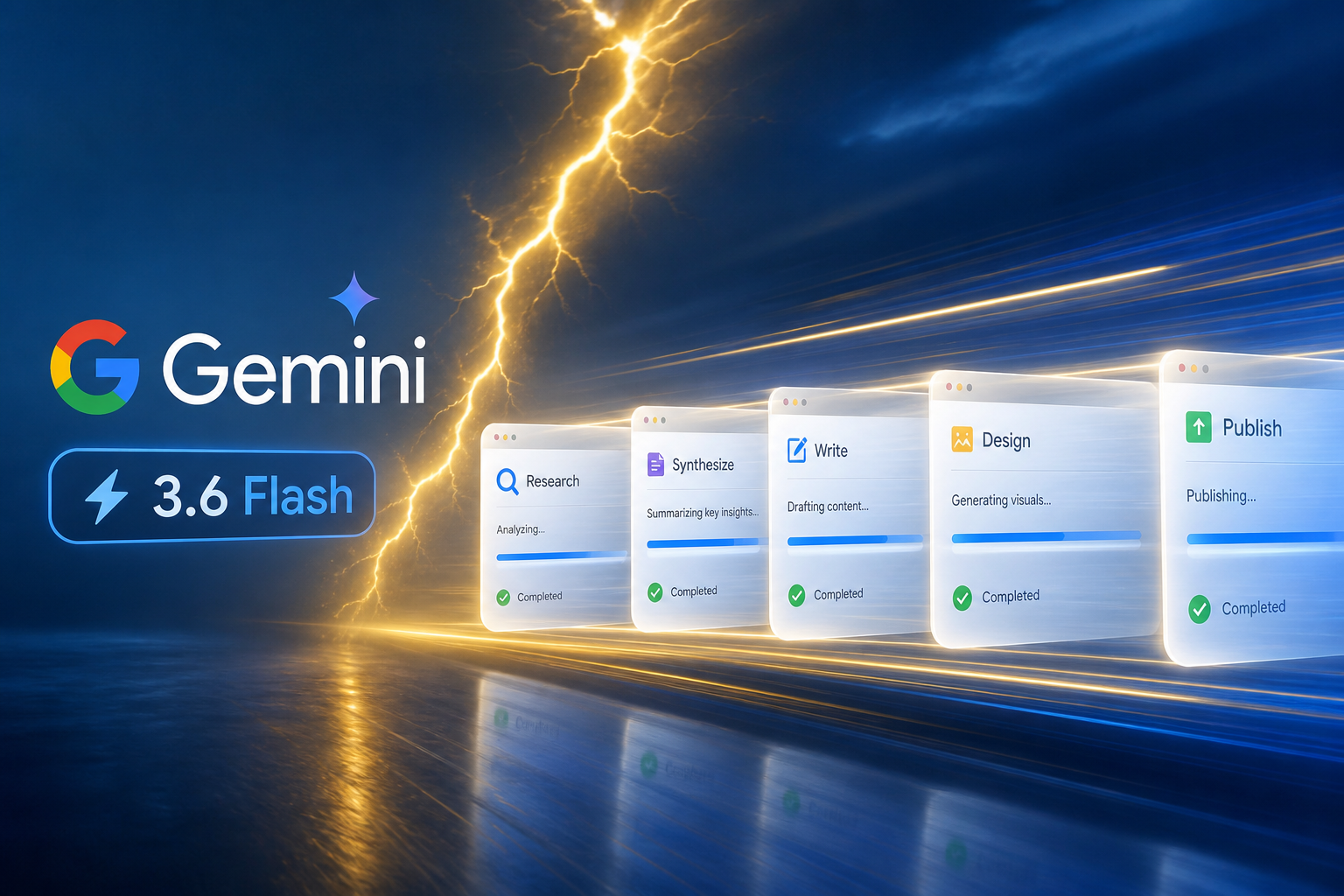
Gemini 3.6 Flash is Google’s July 2026 speed-tier model: same $1.50 per million input tokens as Gemini 3.5 Flash, about 17% cheaper output ($7.50 vs $9.00), and stronger scores on coding and knowledge-work benchmarks. For creators, the story is not “another Flash.” It is that the fast model is now good enough to run multi-step agents — the same class of work that used to need a Pro-tier brain.
That shift changes how you write skills, not just how you pick a chatbot.
What actually shipped
Google made Gemini 3.6 Flash generally available on the Gemini API on 21 July 2026, positioning it as the replacement for Gemini 3.5 Flash. The 3.5 model, launched at I/O 2026, already pushed Flash into agentic coding: a 1-million-token context window, tool use, search grounding, and throughput around 289 tokens per second.
3.6 keeps the Flash contract and tightens the economics:
- Input stays at $1.50 per 1M tokens
- Output drops from $9.00 to $7.50 per 1M (thinking tokens usually bill as output)
- Context remains in the 1M-token class
- Google reported double-digit gains on coding, computer-use, and knowledge-work evals versus 3.5
Treat vendor benchmark tables as directional, not gospel. Cross-check the live Gemini API model card and pricing page before you migrate a production workload.
The product you already list in the AI tools directory — Gemini — is the consumer surface. Cursor, Claude, and ChatGPT still matter; Flash-class speed is what makes those tools feel like coworkers instead of oracles.
Why this matters for promptcrates readers
A slow frontier model rewards long, one-shot prompts. A fast agentic model rewards loops: plan, tool call, inspect, revise. That is closer to a Skill than to a single Midjourney paragraph.
If you still paste a 400-word blob and hope, you will waste the speed. Flash will iterate past your mistakes — or compound them.
Three practical consequences:
1. Skills beat chat templates. Write a trigger, required input, and an output contract. Our Skill guide is the format we use in the library. 2. Segment media prompts the same way. Image and video recipes still work better as subject / atmosphere / technical. See Segment Your Prompts Like a Pro and the image prompt guide. 3. Route by job, not by brand. Use Flash-class models for agent loops and drafts. Keep a heavier model for legal, medical, or one-shot reasoning. Browse the library for recipes that already separate those jobs.
If the model can take twenty cheap turns, your prompt should define the loop — not a single perfect answer.
How to rewrite a skill for Flash-class agents
Take a research-to-brief skill you already run in Claude or ChatGPT and tighten it for Gemini:
Trigger. “When I paste a news URL plus a target audience, produce an original brief — do not quote the source.”
Input. Source URL, audience, must-cite facts, banned claims.
Output. Headline, 40-word lede, three sections, FAQ of four questions, two internal links, one image brief.
Then add a loop instruction the old Pro-era templates skipped:
- After each tool call, restate what you learned in one sentence
- If a number is unverified, mark it
unconfirmedinstead of inventing a source - Stop after three revision passes unless the user asks for more
That last line matters. Fast models will happily spin. Duration discipline is the same idea we use in video prompts: say how long the motion lasts, or the model invents wallpaper.
AIO, GEO, and SEO notes for this story
If you are publishing industry news — this article included — write for three readers at once: Google, answer engines, and a human skimming on a phone.
- Answer first. The opening paragraph should survive as a citation: who, what, when, the one number that matters.
- Name the entity. “Gemini 3.6 Flash” in the title, lede, and one H2. Do not hide it behind “Google’s latest model.”
- FAQ in the page. Answer engines lift Q&A blocks. Keep answers to two sentences.
- Internal links with real anchors. “Skill guide” beats “click here.” Point to guides and news that extend the claim.
- Original image. Generate a 16:9 feature. Do not lift a press screenshot. Alt text should describe the scene, not stuff keywords.
What to watch next
Gemini 3.5 Pro was announced beside Flash at I/O and has been slow to reach general availability. If Pro lands with a longer-context retrieval edge, keep Flash for agents and Pro for needle-in-haystack research.
Also watch output-token burn. Thinking tokens often bill at the output rate. A “cheap” Flash agent that reasons out loud for 8,000 tokens can cost more than a short Pro answer. Log tokens per successful task, not tokens per call.
For music and video teams, the same speed story is arriving in generators — but the prompt craft is still structure, not adjectives. Start from the Suno guide and the video workflow if your next test is media, not code.
FAQ
What is Gemini 3.6 Flash? Google’s July 2026 Flash-tier model for the Gemini API. It is built for fast, multi-step agent work — coding loops, tool use, and long-context drafts — rather than one-shot frontier reasoning.
How is it different from Gemini 3.5 Flash? Same input price ($1.50 / 1M), lower output price ($7.50 vs $9.00), and Google-reported gains on coding and knowledge-work benchmarks. 3.6 is the model Google is pushing as the 3.5 replacement.
Should I move my prompts from ChatGPT or Claude to Gemini? Move the *job*, not the brand. If the job is a tight skill with tools and a stop condition, Flash-class models are now a default. Keep a slower model for high-stakes reasoning. Test the same skill in Gemini, Claude, and ChatGPT before you rewrite the library card.
Does this change how I write image prompts? Not the three-layer system. Subject, atmosphere, and technical still beat a single paragraph. What changes is the *wrapper skill* that generates or revises those layers in a loop.
Is Gemini 3.6 Flash free? The Gemini consumer app has a free surface. API usage is metered. Confirm current rates on Google’s pricing page before you quote a client.
Sources
- Gemini 3.5 Flash model card — Google AI for Developers
- Industry coverage of the 21 July 2026 3.6 Flash GA and the $7.50 output rate (verify against Google’s live pricing page)
Reviewed by promptcrates Editorial · Keywords: Gemini 3.6 Flash, Gemini 3.5 Flash, agentic AI, skill prompt, AI coding agents