Qwen3.8-27B Puts Frontier-Class Local Agents on a Desktop
Alibaba dropped Qwen3.8-27B on Hugging Face around 15 August 2026. The 27B dense multimodal model scored 52 on Artificial Analysis’s Intelligence Index and 3 million downloads in three days — enough to run coding agents on a desktop, no cloud API required.
AI Research Team
Staff Writer
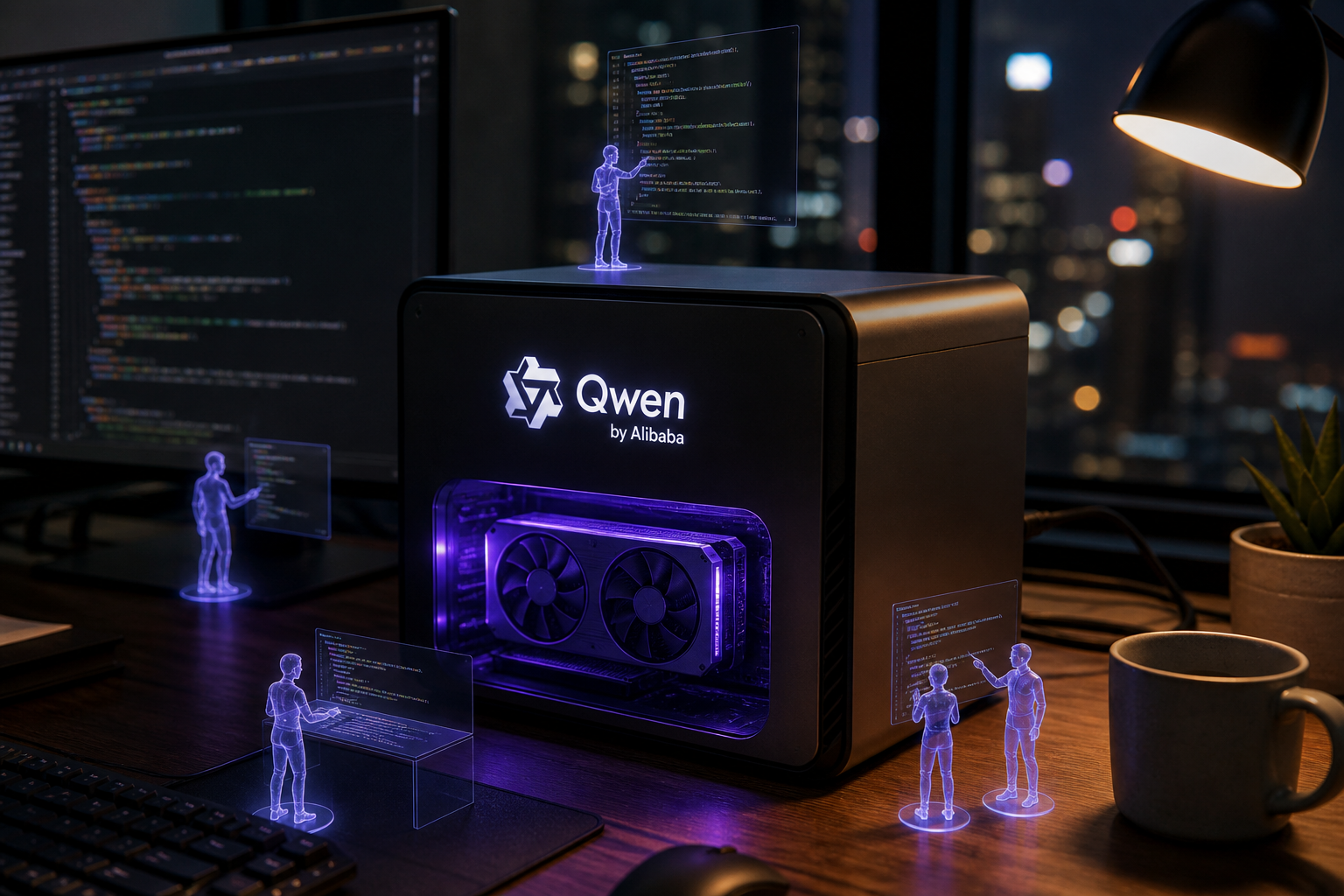
Alibaba’s Qwen3.8-27B landed on Hugging Face around 15 August 2026 under Apache 2.0: a 27-billion-parameter dense multimodal model with a 262,144-token context that scored 52 on Artificial Analysis’s Intelligence Index — the same mark as OpenAI’s GPT-5.6 Luna at max reasoning. Developers pulled it three million times in three days because it runs coding agents on hardware they already own.
That is the story. Not another cloud frontier. A file.
What Alibaba actually shipped
Qwen3.8-27B is the compact slice of the Qwen3.8 generation: native image and video understanding, configurable reasoning, coding and agent loops, weights you can inspect and host yourself.
Hardware math is why the feed exploded. FP8 needs about 28GB of GPU memory. A 4-bit quantization lands near 17GB — a high-end gaming desktop or a well-equipped laptop, not a rack. Full 16-bit still wants roughly 56GB.
VentureBeat’s 17 August 2026 report is the clearest English wrap of launch week. Treat Alibaba’s own table as directional. The company published 61.7 on SWE-bench Pro, 90.3 on LiveCodeBench v6, 70.7 on CoWorkBench, and 84.3 on OSWorld-Verified. Harnesses differ across vendors. Do not declare a universal winner from one chart.
The third-party number that moved people
Monday’s third-party scores did the real work.
Artificial Analysis gave Qwen3.8-27B a 52 on the Intelligence Index, a nine-eval composite of coding, science, reasoning, and professional tasks — the same score it currently assigns GPT-5.6 Luna at maximum reasoning, a model you only get over an API.
On the Agentic Index, Qwen3.8-27B scored 51 and beat Claude Opus 4.8 at max effort, a frontier Anthropic shipped less than three months ago. Equivalent is the wrong word. Close enough on a workstation is the right one.
If you already route cheap loops through Gemini 3.6 Flash, this is the other half of the map: the same agent class, with no egress.
17GB, a pelican, and 21 minutes
Simon Willison ran a roughly 17GB Q4_K_M quant on an M5 Max MacBook Pro and an Nvidia DGX Spark. It wrote code, read images, and drove a coding-agent loop. It explained authentication in a codebase. It wrote a JSONL-to-Markdown utility he actually needed.
The catch is overthinking. Qwen defaults to xhigh reasoning. Willison asked for an SVG of a pelican riding a bicycle. The model burned more than 22,000 reasoning tokens and took 21 minutes before it drew the bird. He now starts ordinary local jobs at low or no reasoning.
Artificial Analysis saw the same tax at scale: 160 million output tokens across Intelligence Index testing, versus a 43 million median for comparable open-weight models. Hosted APIs still feel snappier. Privacy does not.
How to prompt a local frontier, not a chatbot
A 262k window tempts you to paste the whole repo. Don’t. Local agents still need skills, not chat templates: a trigger, required inputs, and a stop.
Write it the way our Skill guide specifies:
- Trigger. “When I drop a repo path and a failing test, open a coding-agent loop.”
- Input. Path, test command, files that may change, files that must not.
- Output. Diff, test log, one-paragraph risk note.
- Reasoning. Default
low. Escalate toxhighonly for architecture. - Stop. Three revision passes, then ask.
If you do not cap the loop, Qwen3.8-27B will think until the pelican hatches. Browse the library for recipes that already split task, constraints, and verification.
If the weights live on your disk, the skill should live in a file too. Paste-once chats do not survive a 21-minute think.
What enterprises should actually decide
The useful comparison is not “does 27B beat Opus on a blog chart.” It is whether a model this small can retire a class of API calls: coding agents, document analysis, vision, office loops.
Apache 2.0 changes the compliance conversation. You can inspect weights and serve them with vLLM, SGLang, or TokenSpeed. Alibaba says a managed Qwen Cloud with a 1-million-token default context is coming later. That is a product, not a substitute for the local file.
Cybernews reported the 3 million Hugging Face downloads in three days. Quantized builds showed up for every local tool that matters. Benchmarks still need more independent harnesses. Default reasoning can be painfully wasteful. Three days in, developers are not arguing Alibaba’s table. They are watching a 17GB file do jobs that used to require a vendor key.
FAQ
What is Qwen3.8-27B? Alibaba’s 27-billion-parameter dense multimodal model, posted to Hugging Face around 15 August 2026 under Apache 2.0. It understands image and video, carries a 262,144-token context, and is small enough to run coding agents locally.
How does it score against GPT-5.6 Luna and Claude Opus 4.8? Artificial Analysis’s Intelligence Index gives it 52, matching GPT-5.6 Luna at max reasoning. Its Agentic Index score of 51 beats Claude Opus 4.8 at max effort. Those are composites, not proof the models are interchangeable.
Can I run Qwen3.8-27B on a desktop? Yes, if you quantize. FP8 needs about 28GB of GPU memory; a 4-bit build is about 17GB. Full 16-bit still wants roughly 56GB. A strong gaming desktop or a high-end laptop is the realistic floor.
Why did Simon Willison’s pelican SVG take 21 minutes? Qwen defaults to xhigh reasoning and spent more than 22,000 thinking tokens on a simple SVG. Start local jobs at low or no reasoning and reserve the long think for hard architecture work.
Should I replace Claude or Gemini API calls with this? Replace the *job*, not the brand. Privacy-sensitive coding agents and document loops are the first candidates. Keep a hosted frontier model for high-stakes one-shot reasoning until you have your own evals.
Sources
- Qwen3.8-27B runs frontier-class coding agents and reasoning locally, no cloud API required — VentureBeat, 17 August 2026
Reviewed by promptcrates Editorial · Keywords: Qwen3.8-27B, local coding agents, Apache 2.0, Artificial Analysis, skill prompt