Perplexity Ships Portable Computer, a Local-First Agent on DGX Spark
Perplexity launched Portable Computer with Nvidia on 25 August 2026: a local-first build of Perplexity Computer that runs the harness and models on an Nvidia DGX Spark, with on-device work carrying no per-credit charge.
PromptCrates Editorial
Staff Writer
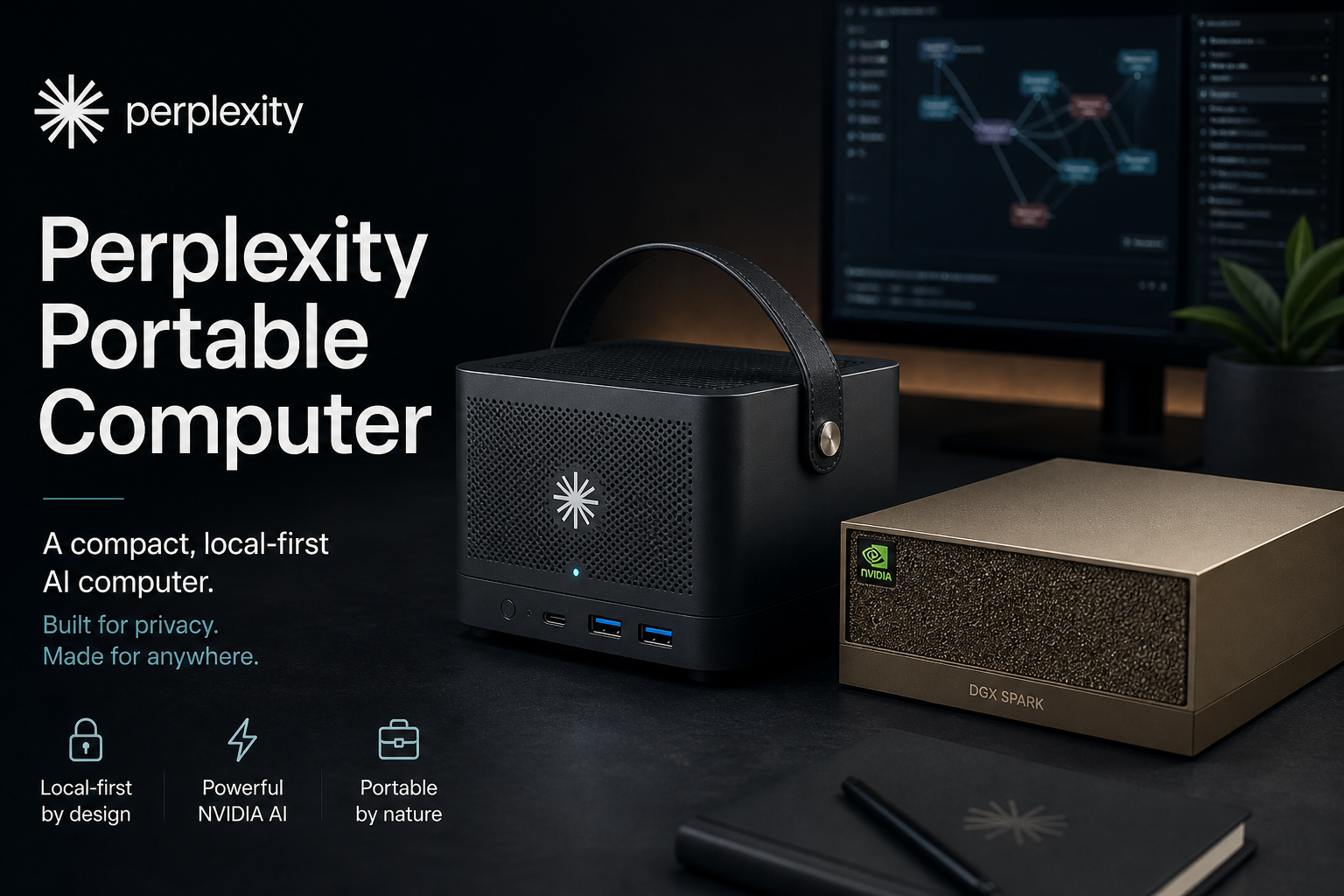
Perplexity launched Portable Computer with Nvidia on 25 August 2026. The local-first build of Perplexity Computer runs the harness and models on an Nvidia DGX Spark, and work handled by those local models carries no per-credit charge.
What Portable Computer runs on the DGX Spark
Portable Computer is not a new cloud seat. It is a version of Perplexity Computer built with Nvidia so the stack can live on a machine the user owns, starting on the Nvidia DGX Spark. The Verge timestamped its coverage at 15:10 UTC the same day and said RTX GPU PCs follow the Spark.
The orchestrator, planner, tool router, scheduler, durable task queue, and local search index all run on device. Launch models are Qwen 3.8 27B or PPLX 27B, a post-trained Qwen. Nvidia Nemotron 3.5 Lightning, a 30B open model, is listed as coming soon. Two weights are here. One Nvidia model is a promise. Do not treat Lightning as a picker option you can pin today.
The DGX Spark is Grace Blackwell GB10: a 20-core Arm CPU, an Nvidia GPU, and 128 GB of unified memory. Availability is Pro and Max subscribers on that box. The first release is Linux, with Windows support coming soon. Install is one-click through the Perplexity app.
That hardware list is the gate. If you do not have a DGX Spark, this launch is not your runtime today. Windows is "coming soon." RTX PCs are the follow-on The Verge named, not the day-one ship.
Connectors named in the launch post are Google Drive, Gmail, Slack, and GitHub. Dictation runs locally with the Nvidia Nemotron 3.5 ASR model. Code and tool execution run in isolated sandboxes. A local agent that cannot see Drive or the repo is a demo. A local agent that can see them, and that asks before a file leaves the box, is the product Perplexity shipped.
If you already track Nvidia's 15 percent AI server price notices for 2027, keep that as a hyperscale rack letter. Portable Computer is a desktop-sized GB10 box with 128 GB of unified memory. One is a 2027 BOM. The other is a 2026 local agent that starts on Spark.
Credits, permission, and the sandbox that cannot be off
Work handled by local models has no per-credit charge. When a step needs the web, connectors, or one of 15-plus cloud frontier models, the local orchestrator asks permission before sending that step off-device.
Zero credits is a local-work claim. It is not a claim that every task stays local. The default is on-device. The escape hatch is an asked permission. Perplexity's research post says the orchestrator is deterministic harness code, not another language model. The local model proposes the next action. The orchestrator executes approved tool calls in an OS-level sandbox and returns the results.
Isolation is not a toggle. If the sandbox is unavailable, the harness disables itself before any tool calls rather than falling back to unsandboxed execution. Tools cannot run without that boundary. That is a different default from the open-source harnesses Perplexity used as comparison lines.
Named connectors still cross the device boundary only when the user authorizes the step. The launch example is a term sheet that stays local while the agent asks to go to the cloud for current market comps. Dictation audio stays on the machine. Do not invent a list of what a classifier flags before an advisor call. The launch note does not publish one.
If you already watch Keenable's $26 million web-search index for AI agents, keep index and on-device search apart. Keenable is a hosted web index other agents can query. Portable Computer's local search index sits on the Spark next to the planner and the task queue.
What the 53-task bench, and the two public sets, actually said
Perplexity's 25 August research blog reported an internal Local Knowledge Work Bench of 53 tasks on a DGX Spark. Computer plus Qwen 3.8 27B scored 82.6 percent versus 77.6 percent for Pi and 74.0 percent for Hermes. PPLX 27B scored 85.4 percent. The company said it ran three trials per task.
Company-reported is the disclaimer. This is not an outside lab. The host in the cited run is a DGX Spark. The stack is Computer plus Qwen 3.8 27B, or Computer plus PPLX 27B. Pi and Hermes are the comparison harnesses Perplexity named. Do not write 85.4 percent into a customer SLA. Do not write 53 tasks as a public standard. Do not assume an RTX PC will match a Spark print.
On the same on-device Qwen 3.8 27B, Computer reached 66.7 percent on 1,266 BrowseComp tasks versus 50.2 percent for Pi and 43.9 percent for Hermes, and 65.1 percent on ParseBench-100 versus 34.6 percent for Hermes and 13.9 percent for Pi. Those two sets isolate the harness, not the post-train. PPLX 27B is the higher score on the internal 53-task bench. Both launch weights still ship.
If your finance owner is already reading OpenAI's Jalapeño InferenceX numbers at Hot Chips, keep custom-chip serving on its own line. Jalapeño is OpenAI's inference ASIC. Portable Computer is a local agent on a GB10 desktop. One is a rack scorecard. The other is a no-credit local loop that asks before it leaves the box.
What to pin if the work is supposed to stay on device
Put the box, the seat, and the permission ask in the wrapper. Name the person who may grant a cloud step. Name whether the seat is Pro or Max.
The useful changelog line is local-first Computer, no credits on local work, asked permission for a frontier step, Linux on Spark today, and two 27B launch weights. A paragraph that only says "Perplexity now runs offline" does not belong in the changelog.
Sources
- Introducing Portable Computer for local-first AI — Perplexity, 25 August 2026
- A local-first agent for private and cost-effective knowledge work — Perplexity, 25 August 2026