Amazon Adds 2 Million Nvidia GPUs, Tripling Its AWS Order
Amazon and Nvidia announced on 26 August 2026 that another 2 million Nvidia GPUs will go into AWS data centers in 2027 and 2028. The add roughly triples a commitment of more than 1 million GPUs that Amazon made five months earlier.
PromptCrates Editorial
Staff Writer
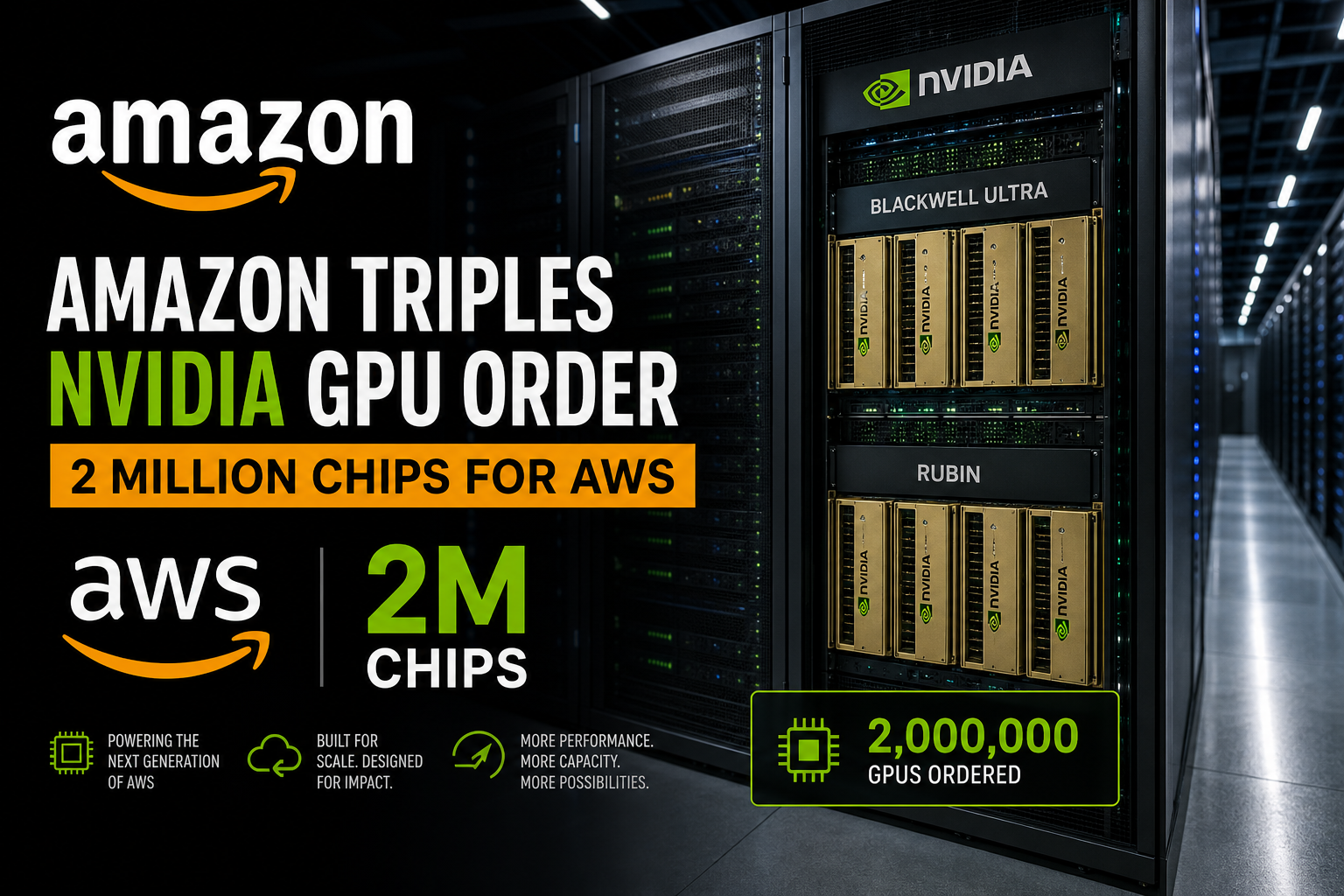
Amazon and Nvidia said on 26 August 2026 that they will add another 2 million Nvidia GPUs to Amazon Web Services data centers in 2027 and 2028. The expansion, announced on Nvidia's quarterly earnings call, roughly triples a commitment of more than 1 million GPUs that Amazon made five months earlier.
What the extra 2 million Nvidia GPUs actually include
The named chips are Nvidia Blackwell Ultra, Rubin, and Rubin Ultra. TechCrunch said they are the GPUs designed for the heavy compute of training and running AI models, and that they will head to AWS in 2027 and 2028. That delivery window is the one to pin. Do not collapse it into a 2026 rack count.
Five months earlier, Amazon had agreed to deploy more than 1 million Nvidia GPUs across AWS infrastructure starting in 2026. Nvidia's statement on the new add was short: since then, "demand has exceeded those expectations." The companies attributed the larger order to "surging demand" from startups, enterprises, AI labs, and governments.
Neither side published financial terms. TechCrunch's estimate, grounded in GPU unit costs rather than a leaked contract, is that the deal is worth tens of billions of dollars. Tens of billions is the ceiling of what the reporting supports. A per-chip sticker is not in the piece.
The announcement is not only a purchase order. Nvidia said its networking hardware for tying thousands of GPUs into one system, plus its open models, CPUs, data-processing software, and robotics platform, will also be integrated across AWS. Treat those as a wider partnership, not as extra GPU volume.
If your 2027 budget already prices Nvidia's 15% AI server hikes, keep list-price and unit-count on two lines. This story is how many more chips AWS said it will take. The hike story is what those racks may cost.
Why AWS still buys Nvidia while it builds Trainium
Amazon has been building its own chips to lessen its dependence on Nvidia. TechCrunch put that tension in the same article as the 2 million GPU add. Amazon's AI chief Peter DeSantis has said AWS is in talks to sell Trainium — a direct alternative to Nvidia's H100 or Blackwell chips for deep learning — to other companies for use in data centers. Amazon's Arm-built Graviton CPU is the parallel challenge on general-purpose servers.
Amazon has also said the custom-chip business is growing. On its last earnings call it crossed a $25 billion annualized revenue run rate, driven by $225 billion in total commitments from AI labs such as Anthropic and OpenAI. Those two figures are Amazon's, relayed by TechCrunch. They are not the price of this Nvidia order.
The coexistence is the point. AWS is not announcing a Trainium sunset. It is adding 2 million Nvidia GPUs while it sells its own accelerators and books custom-chip commitments. Nvidia remains the default AI GPU, and Amazon is still writing a larger check for it.
Colette Kress, Nvidia's CFO, said that with the 2 million GPU chips Amazon is adding, Nvidia also plans to send an unspecified number of Vera CPUs, some integrated with Rubin and others standalone. Do not invent a Vera unit count. Unspecified means unspecified.
Kress also said Nvidia expects Vera to be deployed by every major hyperscaler, neocloud, AI lab, and system OEM, with shipments already underway to lead partners that include Oracle and SpaceXAI. That is a Vera distribution claim, not an AWS exclusive.
If you already track OpenAI models inside AWS Kiro, keep Kiro as a coding-agent surface. This announcement is capacity underneath that surface, not a new Kiro SKU.
What else Nvidia is wiring into Amazon
The partnership spills past training clusters. Kress said Amazon plans to adopt Nvidia's full physical AI stack for its warehouse robot fleet: Omniverse for simulation and digital twins, Cosmos as a world-model platform, Isaac for robotics development, and Jetson as the on-robot compute. Nvidia also introduced a new Jetson this week aimed at entry-level edge AI. That robotics stack is part of the same Wednesday announcement. It is not a substitute for the 2 million GPUs.
On the enterprise side, AWS will serve Nvidia's Nemotron family of open models on Amazon Bedrock and SageMaker. That is a model-hosting line, not a GPU line. Pin it separately if your team already picks Bedrock models.
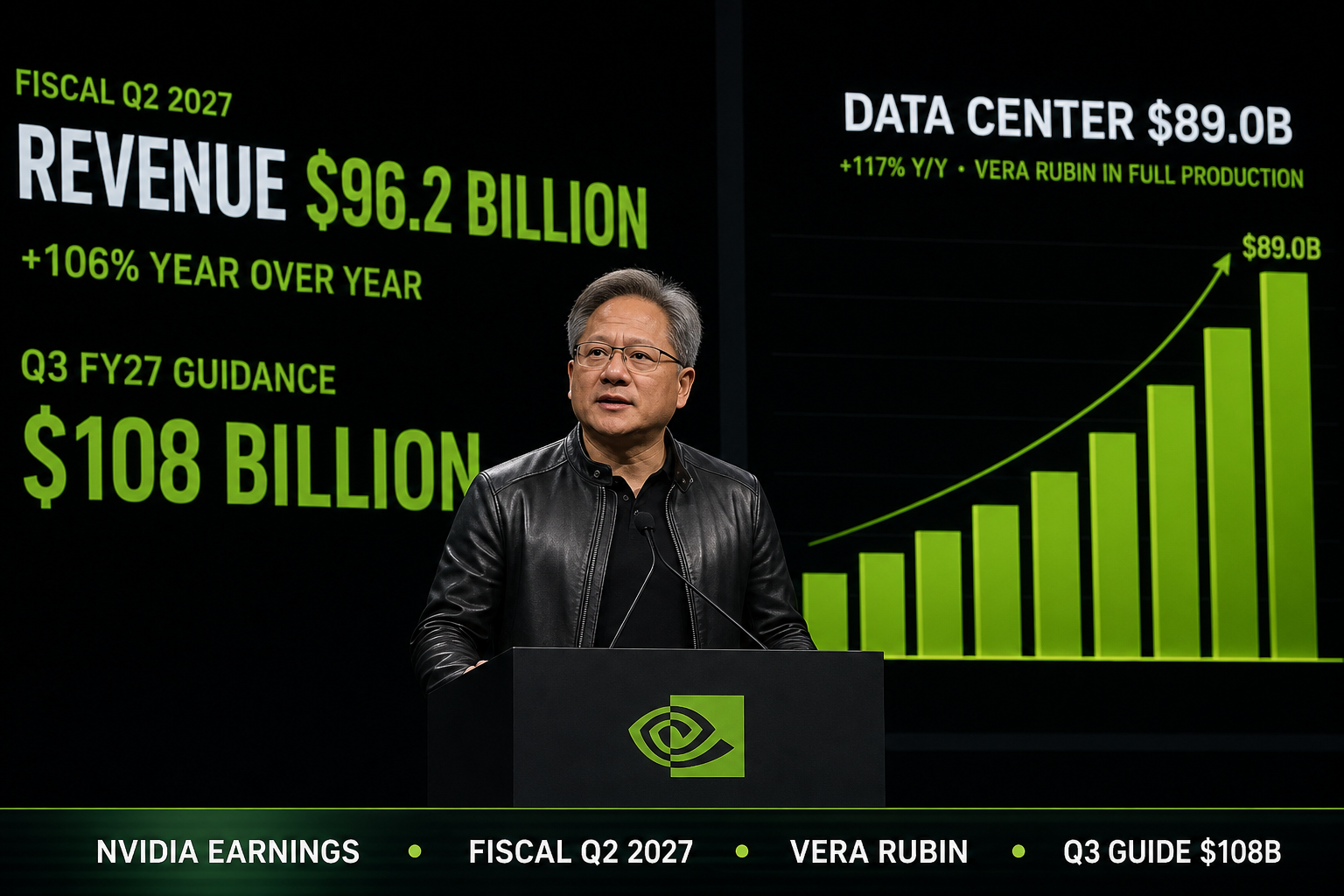
The earnings call around the order is the demand backdrop, not the contract. Nvidia recorded $96.2 billion in second-quarter sales. Data-center revenue was $89 billion, up 117% from a year ago. The company said it expects $108 billion in third-quarter revenue, some of it from next-generation Rubin GPUs, and that it began production shipments of Rubin this quarter. Those are Nvidia totals. They are not Amazon's bill.
Nvidia also said it has committed $279 billion to secure supply and manufacturing capacity for current and future data-center projects, up from $119 billion last quarter. That commitment includes $92 billion in projected spending for the rest of the fiscal year and another $87 billion in fiscal year 2028. Jensen Huang's comment on the call was that AI is generating profitable tokens and that more compute would generate more of them. Investors, TechCrunch noted, will test whether extra compute translates that neatly into extra profit.
If you already follow IBM's consulting partnership around GPT-5.6, keep services and silicon apart. IBM-OpenAI is a delivery motion. Amazon-Nvidia is a rack-count motion.
What to pin if you already buy AWS compute
Put the unit count, the years, and the non-price in the wrapper. A sentence that only says "Amazon doubled down on Nvidia" hides the 2 million figure and the 2027–2028 window.
The useful pin is: on 26 August 2026 Amazon and Nvidia said AWS will take another 2 million GPUs — Blackwell Ultra, Rubin, and Rubin Ultra — in 2027 and 2028; that add roughly triples a more-than-1-million GPU commitment from five months earlier; no financial terms were published; TechCrunch estimates tens of billions; networking, Nemotron on Bedrock and SageMaker, Vera CPUs, and a warehouse robotics stack are part of the same partnership; Amazon is still building Trainium and last cited a $25 billion custom-chip run rate against $225 billion in lab commitments.
If you run training or inference on AWS, the operational change is planned capacity, not a new instance family announced in that piece. Ask your account team which of Blackwell Ultra, Rubin, and Rubin Ultra you can actually reserve, and in which year. The earnings-call headline will not schedule that reservation.
Sources
- Amazon just tripled its order of Nvidia chips over 'surging demand' — TechCrunch, 26 August 2026